event · evt_qeiyafa_ostracon_production
Production and deposition of the Khirbet Qeiyafa ostracon
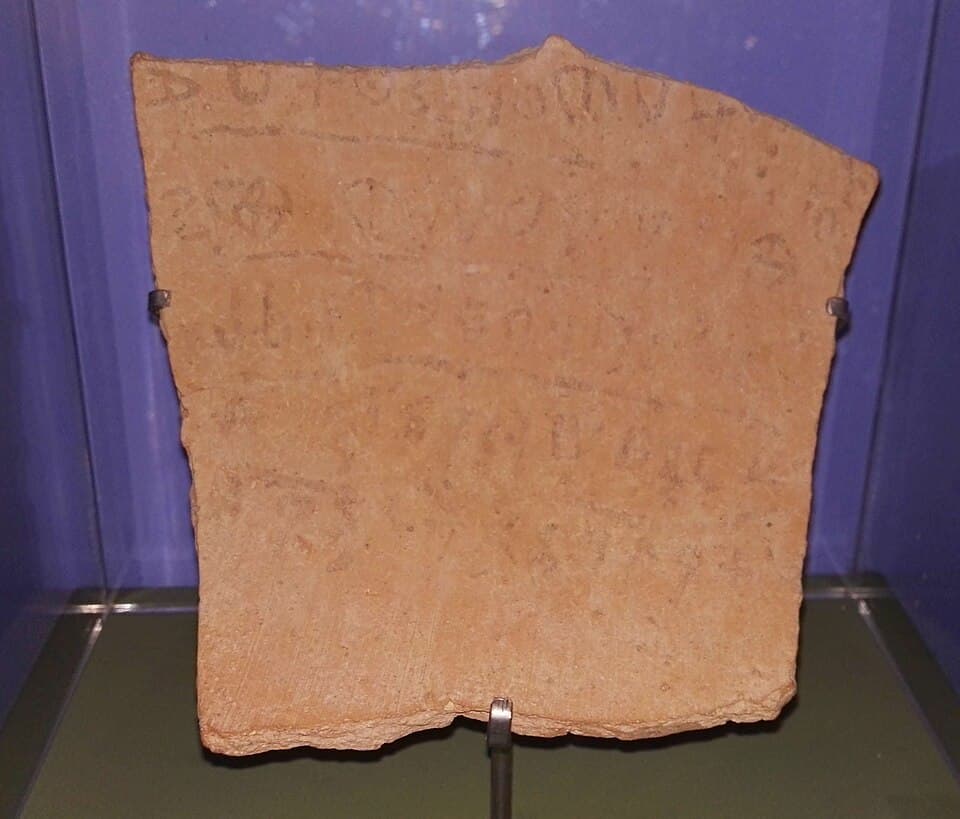
A five-line alphabetic text was written on a sherd and deposited in the fortified occupation context.
What is the evidence?
observation
A five-line alphabetic text was written on a sherd and deposited in the fortified occupation context.proposed causes
The object and context are secure; almost every textual reconstruction remains contested.
Inspect the sources →Review and provenance
Specialist reviewer: not recorded. Review date: not recorded.
Dataset workflow: proposed. This is separate from specialist review.
Confidence describes the stated assessment; it does not certify expert approval. How review works.
Chronology
Dating intervals may describe uncertainty or phases; their width alone does not establish event duration.
1050 BCE–970 BCE
Precision: approximate range
Chronology model: best current range
highThe object and context are secure; almost every textual reconstruction remains contested.
- informs · proposes interpretation
The Khirbet Qeiyafa Ostracon: A New Collation Based on the Multispectral Images, with Translation and Commentary — Brian Donnelly-Lewis (2022)Provides a recent reading.
Locator: multispectral collation, lines 1-5 - informs · dates
Absolute Chronology of Khirbet Qeiyafa — Yosef Garfinkel, Katharina Streit, Saar Ganor, Michael G. Hasel (2015)Dates the archaeological context.
Locator: occupation radiocarbon context
Interpretation and caveats
Direct evidence for local alphabetic writing, while language, reading, administrative function, and relation to biblical literature remain disputed.
Event context
Classification
Event type: literacy and inscription event
Evidence layer: archaeological
Timeline role: regional core
People and places
Locations: Khirbet Qeiyafa, Khirbet Qeiyafa
Why it matters to the timeline
The ostracon informs early literacy and state-capacity debates but cannot independently identify the site's polity.
Alternative interpretations
- The earliest securely identifiable Hebrew legal text.
- A Canaanite or mixed-language scribal exercise or list.
- A formal administrative summons.
Research notes
- Provides a recent reading. Role: proposes interpretation. Locator: multispectral collation, lines 1-5.
- Dates the archaeological context. Role: dates. Locator: occupation radiocarbon context.
Evidence and sources
- informs · dates
Absolute Chronology of Khirbet Qeiyafa — Yosef Garfinkel, Katharina Streit, Saar Ganor, Michael G. Hasel (2015)Dates the archaeological context.
Locator: occupation radiocarbon context - informs · proposes interpretation
The Khirbet Qeiyafa Ostracon: A New Collation Based on the Multispectral Images, with Translation and Commentary — Brian Donnelly-Lewis (2022)Provides a recent reading.
Locator: multispectral collation, lines 1-5
Referenced records
- Khirbet Qeiyafa · entity